Whaling as industrial extraction
The WhaleWhaling as industrial extraction is the transformation of living whales into commodities that powered industries, supplied food and materials, and generated fortunes. In the book, the whale is at once an animal encountered in an immense and difficult-to-know sea, a source of wealth and work, and a resource whose extraction helped build the modern world. That transformation links the bodies of whales to ships, factories, markets, and shoreside prosperity; it also brings industrial ambition into direct conflict with the survival of the species being exploited.
The ocean as a field of extraction
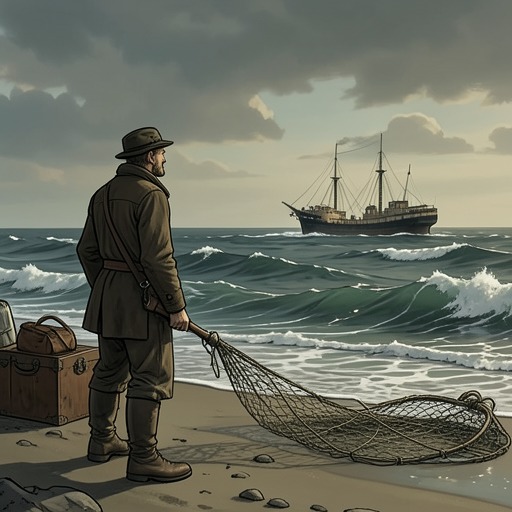
The sea is not presented as an empty space awaiting human use. Drawing on Henry David Thoreau, the book emphasizes its enduring wildness and the limits of human knowledge: beneath a surface that can appear calm or familiar, the ocean remains a vast environment with its own movements and dangers. The contrast matters because industrial whaling depends on treating that difficult world as a territory of supply. In the narrator’s account, people can mistake distance crossed by ships or aircraft for mastery over the sea, even as the ocean continues to shape movement, shorelines, and human boundaries.
Whalers brought people into unusually close contact with whales, but that intimacy was structured by the hunt. The animal could mean food, livelihood, trade, and the prospect of wealth; it could also mean death and disaster for the people pursuing it. Men faced whales from small boats, placing human lives directly in the path of immense animals. The book therefore describes whaling not simply as a trade in raw materials, but as a high-risk encounter in which economic ambition and the physical vulnerability of both hunter and hunted were inseparable. In its broader argument, the modern world was built in part on this encounter, while the near-extinction of whales raises the question of what the human side of the exchange cost beyond money and materials.
Ports, labor, and the repeating voyage
The whaler is likened to a miner working at sea: a worker extracting oceanic oil in a trade that helped stoke the Industrial Revolution and its demand for energy. Whale oil and baleen became Machine Age commodities. The comparison also exposes the labor system behind the output. Owners and captains, seeking higher returns, used punitive practices familiar from mills and factories, reducing pay and provisions. The whale’s body became a source of value, while the people who pursued and processed it worked within an economy organized around profit and repeated production.
On the waterfront of New Bedford of Whaling's Decline and Whale-Oil Industry Debates, the industry’s scale is visible in the piles of casks, ships being prepared for long voyages, and the work of carpenters and coopers. Ships returned laden with the products of a hunt; empty holds were supplied for the next voyage, and loose barrel staves could be assembled aboard ship to store what was brought back. Pitch was melted and equipment repaired beside the wharves. The end of one dangerous voyage thus opened onto another, while the port’s industries and trades kept the process in motion. The book presents this recurrence as both energizing and exhausting: whale products and human effort passed through a system that seemed to have no natural stopping point.
The profits did not remain at the waterfront. The book connects New Bedford’s opulent houses and gardens to the Atlantic, Pacific, and Indian oceans: each display of wealth represents, in material terms, a transfer from sea to shore. This contrast between the industrial wharf and the prosperous street makes the cost of extraction legible. Shoreline affluence was not separate from the hunt; it was one of its products.
From whale to candle, oil, and food
A particularly detailed example of the commodity chain is the production of candles on Nantucket of Moby-Dick and New England Whaling. Introduced to New England in 1748 by Jacob Rodriques Rivera, a Sephardic Portuguese Jew, the technique turned material from the Sperm whale’s head into a refined product. Headmatter brought in from ships was heated in large kettles to remove water and impurities, then stored in casks until it cooled and coagulated. Workers placed it in woollen bags and compressed it in a wooden press. The resulting Spermaceti drained from the press; the first, purest pressing was called winter-strained sperm.
The remaining material also entered production rather than being discarded. It was formed into black cakes and stored until warmer spring conditions made it begin to ooze. A second pressing yielded spring-strained oil. After a third pressing, the remaining brownish matter was heated with wood shavings and potash until it clarified into a white wax suitable for candles. Each stage extracted a different usable product from the same material. The book associates the resulting candles with the island’s commercial wealth: a finely finished consumer good rested on a laborious process of rendering a whale into successive grades of oil and wax.
The uses of whale products extended beyond lighting. By 1948, the British factory ship Balaena returned to Southampton with a cargo that included 4,500 tons of meat, 163,000 barrels of edible oil intended for margarine, 10,000 barrels of sperm oil, 170 tons of meat extract, and a further 3,000 tons of meat for cattle fodder. These figures place whaling within a broad system of national supply, not merely a market for luxury goods. In the immediate postwar setting described by the book, the cargo represented a contribution to the economy and a promise of material provision. The whale had become food for people and animals, as well as oil for manufacture.
Factory-scale production and the cost of abundance
The Balaena embodied the industrialization of the hunt. It carried laboratories, a blacksmith’s shop, and a hospital, and its size and presence rivalled those of ocean liners. At sea, processing could continue aboard the vessel rather than waiting for a return to shore. The factory ship made the whale’s conversion into products part of a continuous operation: capture, processing, storage, and transport were integrated within a fleet.
The account of processing a single whale shows how thoroughly the animal could be absorbed into this system. Boilers below decks reduced blubber to oil stored in large tanks, and a method extracted oil rich in vitamins from the liver. Nothing was treated as surplus when it could be made useful or valuable. One animal yielded 133 barrels of oil and sixty tons of meat, with a stated value of $28,000. These figures give industrial extraction its concrete measure: a whale’s body was converted into quantities that could be counted, stored, priced, and carried away.
The book sets this efficiency against the remoteness of the work. The fleet operated far from land, and injured men could die without a hospital to which they could be taken. At the same time, the whaling grounds could be described as waters belonging to no one, a formulation that exposes how distance and weak responsibility enabled continued extraction. Official observers and biologists might be present, but the presence of regulation and scientific study did not, by itself, prevent the hunt from taking animals that the rules were meant to spare. Industrial productivity and oversight thus existed alongside persistent gaps in protection.
Energy transition and ecological consequences
The industry’s dependence on whale oil made it vulnerable to new sources of energy. Kerosene and coal gas began lighting streets and homes from the 1840s. At first, the appetite for brighter lighting could also increase demand for whale oil, but the decisive change came in 1859, when Edwin L. Drake drilled for oil on a farm in Titusville, Pennsylvania. The new petroleum supply signalled the end of the Sperm whale fishery and the beginning of a different form of extraction. The transition did not end the human drive to obtain resources; it redirected that drive from ocean life to deposits in the earth.
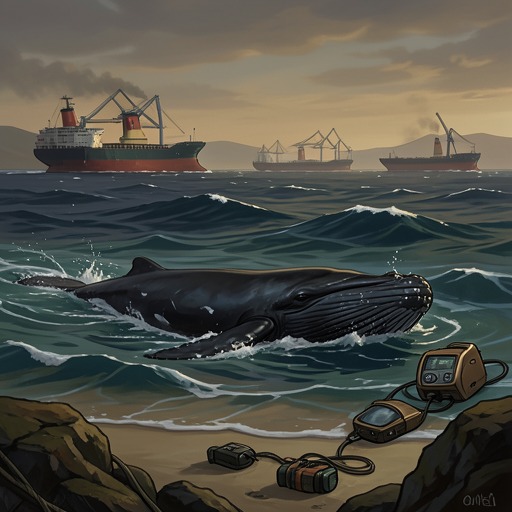
The ecological consequences were not limited to the disappearance of individual animals. The North Atlantic right whale, once heavily hunted for its abundant fat and useful baleen, had fewer than four hundred individuals remaining in the North Atlantic according to the account. Its history illustrates how traits that made a species convenient to hunt could also leave it exposed in the present: it frequents populous shores and busy shipping routes, and its tendency to remain quiet and near the surface makes it vulnerable to passing vessels. Although the species received protection from hunting in 1935, its numbers remained static despite changes to shipping routes and instructions that vessels remain five hundred yards from a whale. The book presents those protections alongside the continued danger, not as proof that the danger has passed.
Whaling also damaged the social knowledge carried within cetacean populations. Research discussed by Hal Whitehead describes cetaceans as problem-solvers who use tools, live in complex societies, and pass abilities between generations. The book argues that twentieth-century whaling may have destroyed not only individual animals but cultural knowledge associated with particular habitats and feeding grounds. In the slow-breeding Sperm whale, population growth is described as only about one per cent a year, making recovery vulnerable to the consequences of earlier hunting. Extraction could therefore remove both animals and capacities that would otherwise support the population’s future.
The book enlarges this concern beyond any single species: while it was being written, the Yangtze River dolphin was declared extinct, and the author warns that other species, including right whales, could face a similar fate. These are presented as risks and forecasts, not as a certainty that every threatened whale will disappear. The governing contrast remains stark, however. A whale’s value to industry could be calculated in barrels, tons, and dollars; the losses caused by depletion include living populations, inherited knowledge, and the possibility of continued life in the sea. Whaling as industrial extraction names both the material system and the imbalance at its centre: a renewable-seeming ocean was treated as an inexhaustible source, while the species on which the trade depended approached the limits of survival.